What Should You Check Before Purchasing Shower Door Handles In Bulk?

In a bathroom, users rarely notice a single screw at first. Instead, they immediately sense the overall quality the moment they open the shower door for the first time. The proportions of the glass shower door handle, its feel in the hand, how it’s attached to the glass, and how its finish complements other hardware—all of these elements can transform a “nice-looking” product into one that “feels reliable.” For project buyers, this isn’t just a minor decorative choice. It’s a crucial element in ensuring that the design intent is faithfully executed.
I. How Does Door Handle Design Affect The Overall Aesthetics And User Experience Of A Shower
The shower door handle is a frequently touched and highly visible component of a shower door. It bridges the transparency of glass with the texture of metal: if the handle is too thick, it can make a frameless glass door appear less visually open. If it’s too thin, it may feel less sturdy when gripped. To ensure the shower’s overall aesthetic stands the test of time, it’s usually best to first consider the proportions of the door panel and the style of the entire hardware set before deciding on the handle’s length, appearance, and connection details at both ends—rather than simply applying a single “high-end style” across all projects. In other words, the choice should be based on the specific door type, the space’s design style, and practical needs.
Handle proportions are only the starting point because you must also consider the practical details of the shower door handle. For example, are the edges of the handle smooth enough? Is it easy to grip firmly? Can you naturally adjust your grip when your hands are wet? And do the handles on the inside and outside of the door maintain a consistent installation centerline on the door? The second step is to check product quality and batch consistency. These checks include documentation of the base material, the structure of the fasteners, the spacers designed to prevent direct contact and pressure between the glass and metal hardware, and whether there are significant variations in color and gloss within the same batch.
If you’d like to familiarize yourself with handles of different shapes, lengths, and finishes, you can start by reviewing the styles and designs of glass shower door handles. Then refer to your project drawings to confirm the glass thickness, mounting-hole locations, and the installation clearance required for the door panel.
II. Different Styles Of Handles Are Suitable For Different Shower Enclosure Designs
Larger door handles aren’t necessarily better, nor is the same installation method suitable for all door types. For contractors and design firms, before selecting a shower door handle, it’s important to first confirm the door type, its opening direction, the position of the door panel edges, and the clearance required for opening and closing the door. Only then should you consider the handle’s appearance and overall style.
When it comes to frameless glass doors, the key considerations for a frameless shower door handle go beyond simply “whether it can be installed.” They also include the required distance between the mounting hole and the glass edge, whether the glass is subjected to localized compression after installation, and whether the handle will hit the wall, hinges, or adjacent door panels during opening and closing.
If a project uses sliding shower doors, it is recommended that when determining the handle specifications, you also confirm the relevant requirements for the sliding shower door hardware system, including track dimensions, door panel overlap, handle projection, and installation clearance to avoid discovering discrepancies between components only during on-site installation.
III.How Does The Material Of Shower Door Handles Affect Long-Term Use
The choice of handle material should be considered in conjunction with the environment, structure, surface finish, and cleaning and maintenance methods. Simply stating that a handle is “heavier” or “harder” does not prove that it is more practical for a specific project.
When selecting stainless steel for architectural applications, you can refer directly to the IMOA Stainless Steel Selection System: environmental conditions, surface finish, design, and maintenance requirements must all be evaluated together, rather than relying solely on the stainless steel grade. For specific projects, the environmental rating assigned to the building’s exterior should not be taken as a guarantee of the handle’s service life. If the project is located in a high-humidity, coastal, or frequently cleaned environment, suitable cleaning products should be specified, and the cleaning frequency should be included in the maintenance plan.
IV. Surface Finishing Is More Than Just Choosing A Color
When selecting a surface treatment process, the color and gloss level are typically determined first. However, for procurement and production purposes, it is also necessary to further specify the detailed requirements, including substrate pretreatment, grain direction, coating or plating process, gloss range, sample approval procedures, and compatibility with routine cleaning agents.
Even when using the same color or surface finish names, the final appearance can vary depending on specific requirements. For example, the base color, surface texture, and gloss level may differ. Therefore, before placing a bulk order, it is essential to confirm the production specifications and review physical samples to ensure that the production units match the actual design.
Daily cleaning of shower door handles: Worldstainless's Guide to Cleaning Architectural Stainless Steel
V. What Details Should You Pay Attention To When Choosing A Good Frameless Shower Door Handle
1. Close Encounter Details Of A Shower Door Handle
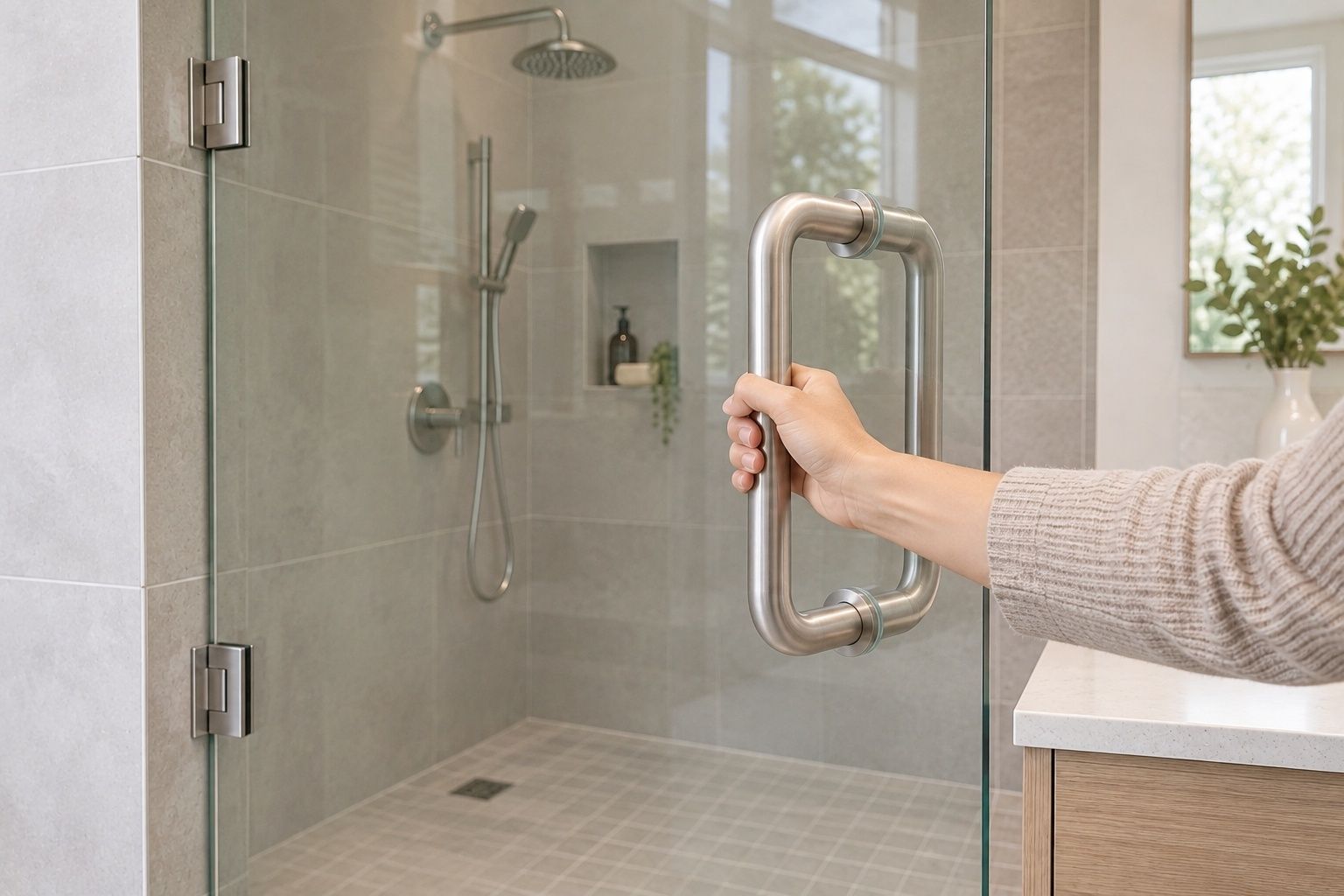
The details of a shower handle are particularly noticeable up close. However, a well-designed shower handle does not rely on excessive decoration to mask imperfections in its edge finishing. Instead, it ensures that your fingers can grip the handle naturally and comfortably when pushing or pulling the glass shower door. At the same time, the connections between the handle’s ends and the grip bar should be neat and symmetrical, and the handle should not appear crooked or loose once installed and secured. In addition, the distance between the handle and the glass is equally important. The handle design must ensure sufficient grip space for comfortable handling, while limiting the protrusion of the handle to prevent obstruction of normal door movement or collision with surrounding walls, fixed glass panels, or other hardware.
2. Detailed Finishes Between The Shower Door Handle And The Glass

For glass shower doors, processes such as drilling, cutting, and edge finishing should be completed before the glass is tempered. If a door handle cannot be installed because the hole in the glass is too small, never attempt to enlarge the hole on-site using tools to resolve the issue, as this could cause the glass to shatter due to operational errors. Therefore, before tempering the glass, refer to the project drawings to confirm the hole diameters, center-to-center distances, glass thickness, spacers, fasteners, and the door’s opening direction in advance to ensure that every component is installed correctly. If you need to ensure the entire shower door assembly is coordinated, you can verify the dimensions, hole positions, and installation clearance for the handles and shower door hinges together.
3. Different Types Of Shower Partition Glass Clamps Produce Different Overall Visual Effects
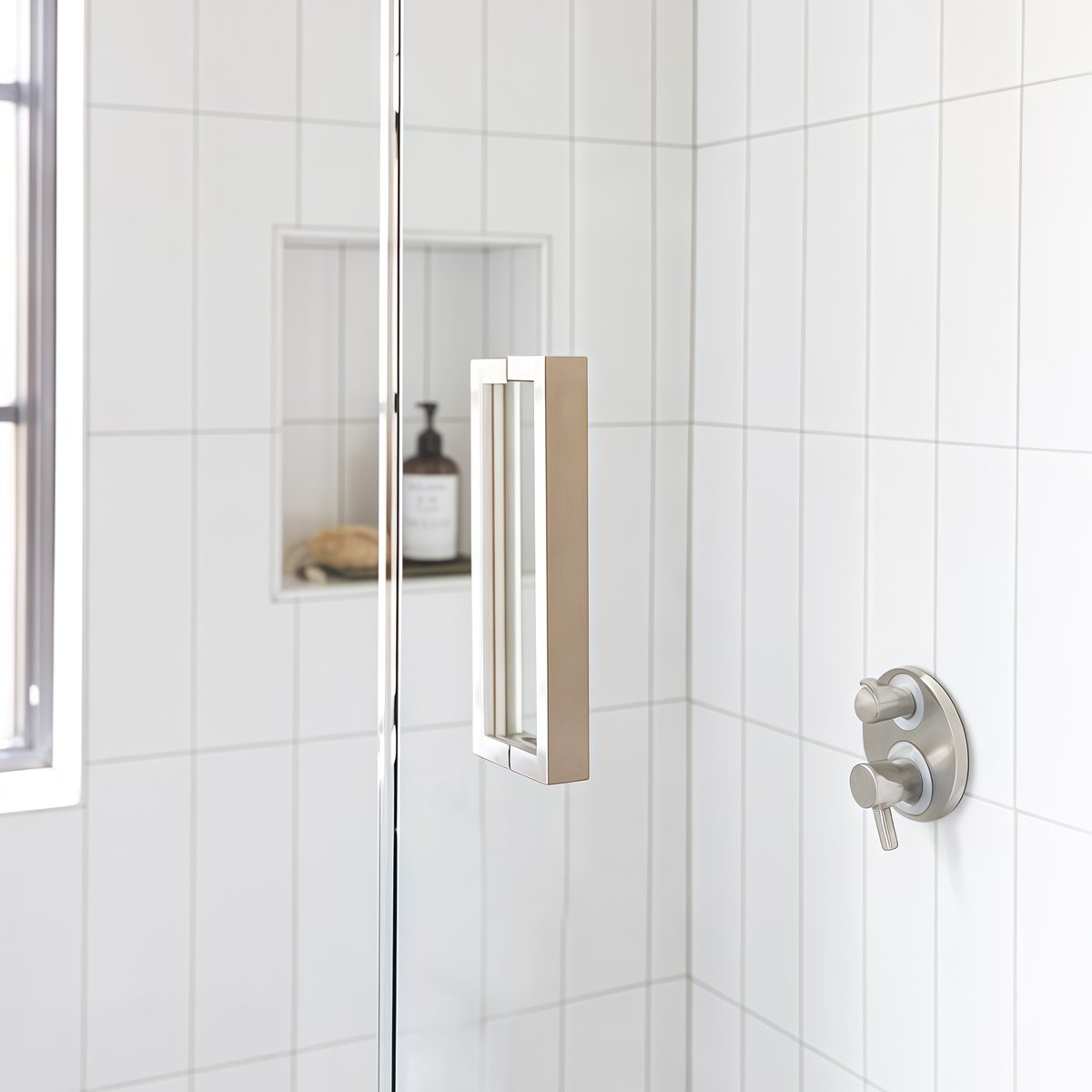
Even if the door handle and bathroom glass clips are the same color, differences in surface finish, edge treatment, and gloss level may result in a mismatched appearance. When selecting hardware for bathroom doors, ensure the glass clips match the shower door handle, and during the sample approval stage, carefully inspect the details of the glass edges, gaskets, and fasteners to avoid creating areas where water can accumulate or that are difficult to clean.
VI. Coordinating And Installing A Complete Set Of Shower Hardware
Generally speaking, the overall feel and user experience of a bathroom are rarely achieved by a single hardware component alone. Rather, they depend largely on how different components are coordinated. For example, consider whether the shapes and proportions of the bathroom door handle and glass clamps are similar, whether the corners align naturally, whether the installation is neat, and whether the surfaces have a lustrous finish. For projects such as hotels, high-end residential units, and multi-unit residential projects, these details are particularly crucial. While every component within a single hardware set may appear similar in color and finish, the layouts and lighting conditions vary from room to room. Therefore, the installation positions and surface finishes of hardware components such as door handles and glass clamps must remain consistent to ensure that every bathroom space is visually harmonious.

When selecting bathroom hardware, the design team should first determine which details need to be consistent, such as color, finish, and overall style. They should then decide on the structure and mounting methods for different components based on the actual installation conditions. If the bathroom project also requires coordinating with other architectural glass hardware ranges, it is best to finalize requirements for related components and surface finishes early in the design process to avoid discovering mismatches in color, style, or installation dimensions during the later procurement phase, which could delay the project schedule.
In some hotel and apartment projects, in addition to the shape of bathroom door handles, it is also necessary to consider practicality and ease of daily cleaning. For example, are the handles on the inside and outside of the door installed correctly? Will the door bump into fixtures or walls when opened? Can cleaning staff move smoothly and naturally while tidying up and wiping down surfaces?
If the project involves a variety of architectural glass hardware components, you can refer to Busrom’s “glass hardware applications for building projects” to learn more about case studies featuring different combinations. Additionally, for projects requiring custom dimensions, sample approval, or further refinement of product specifications, it is advisable to review Busrom’s “OEM & ODM hardware development” in advance to understand the scope of work and delivery requirements for both parties, thereby avoiding miscommunication later on.
VII. Confirmed Items Of B2B Buyers Before Making A Bulk Purchase
When purchasing shower door handles in bulk, you cannot rely solely on claims such as “high quality” to determine whether a product meets the required standards. For wholesalers and distributors, it is more important to clearly define the product specifications, appearance requirements, installation conditions, and manufacturing standards in advance.
↓ ↓ ↓
If a project involves coastal environments, frequent cleaning in hotels, or phased deliveries, it is necessary to confirm the intended service environment, testing requirements, and acceptance criteria in advance. The environmental and testing parameters should be clearly defined according to the ASTM B117 Salt Spray Test Standard. The results of salt spray testing do not directly equate to actual service life, but they can serve as a preliminary basis for evaluating product quality. For commercial projects where replacement costs are high and repairs may disrupt operations, it is also necessary to confirm part numbers, future restocking requirements, and product batch traceability records in advance. This ensures that even if parts need to be replaced or reordered, it is easier to verify the original specifications, thereby reducing additional work caused by product incompatibility.
For a quick overview of handle materials, styles, surface finishes, and more, see “polished stainless steel shower door pull” to learn more. Of course, this should only be used as a preliminary reference for selection. The final selection must be based on actual project drawings and other requirements. If you’d like to learn more about installation methods, dimensional compatibility, and important considerations when replacing handles after installation, see the “shower door handle mounting and compatibility guide” page for more information.
Therefore, only by confirming all the details of these bathroom door handles in advance can you select a style that better complements the overall design of your bathroom and minimize potential issues during installation and future maintenance. If you have already determined the door style, glass thickness, cutout location, and surface finish requirements, or if you need to restock existing shower door handles, feel free to contact us.
VIII. Frequently Asked Questions
1. Q: When Purchasing Shower Door Handles In Bulk, How Can You Ensure That Products From Different Batches Are Consistent In Appearance And Specifications?
A: Before placing a bulk order and starting production, it is necessary to confirm with the factory the material, dimensions, mounting hole spacing, surface treatment, color, and gloss level of the shower door handles, among other details, and to confirm and retain a sample of the final door handle.
2. Q: What Key Dimensions Need To Be Verified For Frameless Glass Shower Door Handles Before Production And Installation?
A: In addition to the handle’s length and shape, you should also verify the glass thickness, cutout dimensions, center-to-center distance between holes, handle projection, spacers, and fasteners, as well as the space required for the door to open. You should also check whether the handle will come into contact with the wall, fixed glass, hinges, or other hardware.
3. Q: For Stainless Steel And Brass Shower Door Handles, How Should You Choose The Right One Based On Project Requirements?
A: When selecting materials, one should not merely compare appearance, weight, or price; it is also necessary to consider the specific material composition, service environment, surface treatment, and maintenance requirements. For example, with stainless steel, attention must be paid to the steel grade, fabrication details, and cleaning requirements in hot, humid environments. With brass, on the other hand, attention must be paid to the base material, surface treatment process, and color stability.
4. Q: How Can You Determine Which Surface Finish For A Shower Door Handle Is Best Suited For Which Scenario?
A: To determine the appropriate applications, consider the frequency of use, ambient humidity, cleaning methods, and design style:
- Hotels & Public Bathhouses: Focus on wear resistance, corrosion resistance, and cleaning and maintenance requirements.
- High-End Residential Properties: Select brushed, mirror-polished, or dark finishes based on the overall design.
- Bulk Procurement Projects: Confirm samples, colors, gloss levels, and textures in advance, and compare them with actual samples to ensure they meet project requirements.
5. Q: When Hotels, Apartment Complexes, And Large-Scale Construction Projects Purchase Shower Door Handles, How Can They Reduce The Costs Associated With Installation Rework And Future Replacements?
A: Confirm the necessary specifications before making a purchase. For projects with multiple room types or those delivered in batches, you must also clearly specify the applicable specifications, packaging and accessory lists, spare part numbers, and reorder requirements for each unit type. Additionally, keep records of product batches and acceptance inspections. This will help verify the original specifications during subsequent repairs or reorders, thereby reducing additional costs resulting from incompatible parts, on-site rework, and project downtime.
