Why Glass Fence Spigot Sizes Matter More Than You Think
Busrom Team
- •
- 4 MIN TO READ
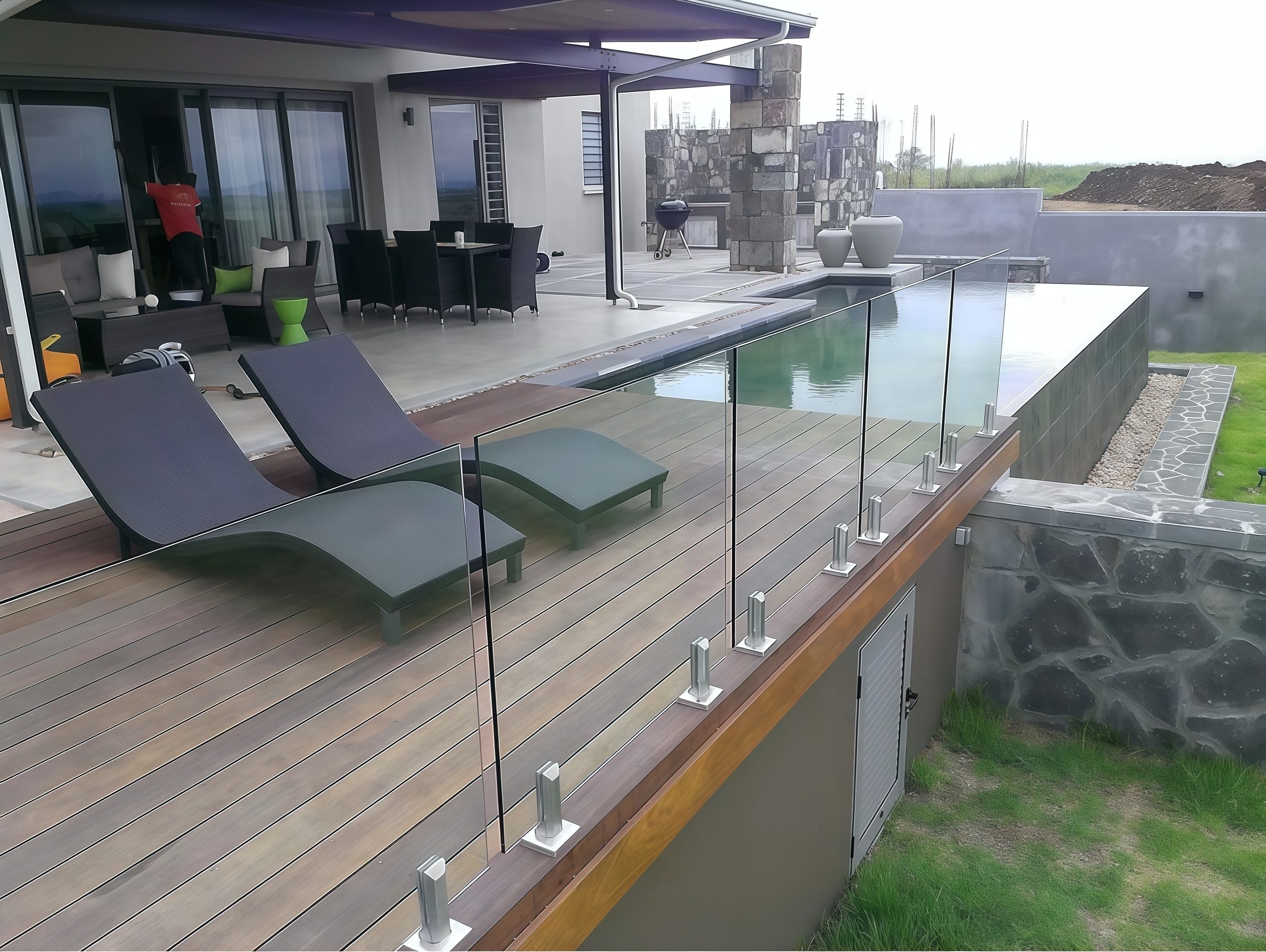
Glass fence spigots are important structural aspects made use of to protect glass panels in frameless glass railing systems. Their dimensional style directly influences the system's total safety and security, wind heaps resistance, and aesthetic appeals. In practical layout applications, there is no singular standard for glass aid dimensions; rather, a comprehensive selection of specs-- ranging from standard to personalized-- has actually progressed based on facets such as glass density, installment ambience, and building wind load requirements.
Amongst common layout applications, unnoticeable and basic glass supports are the most extensively used:
Inconspicuous variations normally vary from 150mm to 180mm in altitude and are primarily established for 8mm to 12mm thick toughened glass. Their reduced general elevation reduces aesthetic obstruction, substantially preserving the feeling of spatial exposure. As a result of their lighter weight, they generally provide wind tons resistance in between 0.5 and 1.0 kN/m two, making them a far better fit for indoor use or settings with low wind loads. Consequently, this kind of aid is frequently employed for indoor stairs obstacles, dividers in commercial areas, and lightweight balcony barriers.
On the other hand, standard glass spigots are typically taller-- typically 200mm to 220mm-- with a base diameter of around 100mm to 120mm, making them very suitable with 10mm to 15mm thick solidified or laminated glass. These control the market, accounting for around 70% of all layout applications, thanks to their optimal balance between structural endurance and cost. They stand for one of the most mature and reputable options for applications such as resort hallways, family verandas, and outside barriers on low- to mid-rise industrial structures.
A lot less typical building dimensions are additionally used in specialized architectural designs or extreme environmental problems.
- As an example, ultra-low-profile glass suffers-- standing simply 100mm to 130mm tall and made for 8mm to 10mm glass-- focuses on severe visual discernment, developing the impression that the glass is "floating." While regularly uncovered in art rooms, premium showrooms, and minimal style jobs, their limited elevation causes fairly reduced wind resistance, making them ideally matched for completely indoor ambiences.
- In contrast to basic variations, there are extra-tall or industrial-grade glass supports-- ranging from 300mm to 350mm in elevation, or perhaps taller-- normally coupled with large-format laminated glass 19mm to 25mm thick. Created for high-wind areas or specialized design settings, these supports concentrate on exceptional strength and protection redundancy; top-quality stainless steel is used to guarantee constant efficiency over the long-term in extreme problems.
What Temperature Ranges Can These Glass Supports Withstand?
Temperature resistance varies by aid demands. Taking stainless-steel as an example, Grade 304 is appropriate for basic urban setups, holding up against temperatures from -20°C to 60°C. For seaside or high-salinity atmospheres, Quality 316 is a better fit, maintaining security between -40°C and 80°C. For even harsher troubles, higher-grade anti-corrosion treatments are put on extensive life spans in extreme settings.
Basically, unnoticeable assistances suit low-wind places, while reinforced and industrial-grade sustains please the needs of high-wind or severe climate conditions. Typically speaking, larger measurements and heavier frameworks supply premium ecological adaptability and higher safety redundancy.
Secret Factors Into Consideration In Design Format
Several task failures stem not from the glass itself, but from the wrong choice of assistance dimension.
1 Sustains that are also quick lack enough wind resistance, causing instability
While the setup may show up risk-free and safe and secure in a fixed state, elements such as regular wind stress or human impact-- particularly on open terraces, roof coverings, or seaside sites-- can create problems. Continuous wind pressure may not be properly dissipated, causing minor swaying of the glass panels.
2 Supports that are as tall along with elevate the center of gravity, endangering architectural stability
A greater center of gravity enhances the moment created when wind acts upon the glass, subjecting the base of the assistance to better pull-out and shear stress. If the ground foundation does not have enough stamina or the anchoring system is terribly developed, the risk of architectural deformation may truly increase.
3 Undersized base producing concentrated stress on support screws
The support base is an important part for moving the glass great deals to the concrete, steel framework, or numerous other mounting structures. If the base diameter or thickness is too small, the lots come to be concentrated in a restricted location, subjecting the anchor screws to too much local stress.
4 Inequality between the securing force and load-bearing capacity as a result of mismatched glass density and assistance dimension
If the glass and the support are inappropriate, the indoor rubber pads and protective system will definitely remain under high loads for extended durations; this not only jeopardizes security, but might likewise boost part wear.
A support is not necessarily much better just because it is larger; the suitable option is matched to the glass density, wind load, and arrangement ambience.
In recap, the architectural dimensions of glass assistance are not chosen arbitrarily. Different glass densities, setup areas, and operating atmospheres require thorough help specifications.
Busrom Team
Editorial Team
Committed To Providing The Highest Quality Indoor & Outdoor Solutions Worldwide.