How Does An Entry Door Handle Influence The First Impression of A Space?
.png) Busrom Team
Busrom Team- •
- 2 MIN TO READ

As contemporary style and spatial design increasingly merge, the entryway door manage has ended up being an important equipment part that bridges visual experience, responsive feeling, and structural compatibility. Often positioned at the primary aesthetic prime focus of an entryway, the deal with serves both functional and aesthetic roles within the total spatial expression. From a user experience viewpoint, the worth of the door deal with lies mostly in its "first responsive and visual high quality" and its "lasting comfort and stability" variables that jointly define its core customer experience.
The style of the door handle commonly communicates the character of an area via its material, proportions, and surface coating. For example, a combed 304 stainless steel surface frequently predicts a restrained, trendy, and modern-day aesthetic, a design often found in industrial structures and minimal residences. To produce a much more striking visual influence at the entry, dark or black coatings are usually employed. Their low-reflectivity properties improve spatial comparison. Practical responses show that brushed-finish manages delight in an approval price in household settings, roughly 15%-25% more than high-gloss mirror finishes. This is mostly because they are less prone to showing fingerprints and offer a softer visual appearance, avoiding the diversion of harsh representations. Moreover, the handle's structural lines directly affect the space's ambience. Direct and elongated styles align with the sense of order located in contemporary style, whereas bent or spherical accounts are better matched to areas that highlight convenience and approachability.
1 Material Compatibility
- Solid timber doors
→ Solid screw interaction + reinforced installing base - Steel door frameworks
→ Anti-vibration framework - Glass doors
→ Specialized clamps or U-shaped installing braces - Lightweight aluminum alloy doors
→ Lightweight doors offer better compatibility
2 Application Scenarios
- Private property entries
→ Longer deals with developing far better aesthetic harmony with taller doors - Industrial entrances
→ SUS304 heavy-duty structures with reinforced bases offer superior toughness - Hotels and public buildings
→ Spherical or curved edges enhance convenience and safety - Lightweight interior doors
→ Compact, rounded, point-mounted styles mix more perfectly with the decoration
Regarding tactile top qualities, distinct differences exist depending on the steel surface finish. As a result of its high thermal conductivity, 304 stainless steel generates a unique "great experience" upon initial contact. A sensation often emotionally taken as a signal of toughness and dependability, which is why it is commonly taken on in industrial structures and high-end homes. Combed coatings, defined by a consistent tiny structure, successfully disperse call stress and stabilize rubbing in between the fingers and the surface area, avoiding the feeling of really slippery or sticky. In contrast, while high-gloss mirror finishes use higher aesthetic impact, they are extra prone to fingerprints and produce a feeling of slight slippage, leading to reduced responsiveness and convenience during frequent usage.
Relating to customer convenience, the experience of an entry takes care of itself depending on grip and operational smoothness. Ergonomically designed takes care of commonly feature a size of 28mm to 38mm, a range thought to be ideal for many adult hands, ensuring a safe and secure hold without causing fatigue throughout long-term use. Round-tube styles normally offer about 20% more convenience than square accounts, as their softer sides prevent producing local pressure factors. Moreover, a well-designed management coupled with a top-quality joint system keeps opening and closing resistance within the comfortable 20-35N variety, enabling natural, fluid activity. For high-traffic industrial spaces, this mix of reduced resistance and high security is important, as it directly forms the individual's overall understanding of the room's top quality.
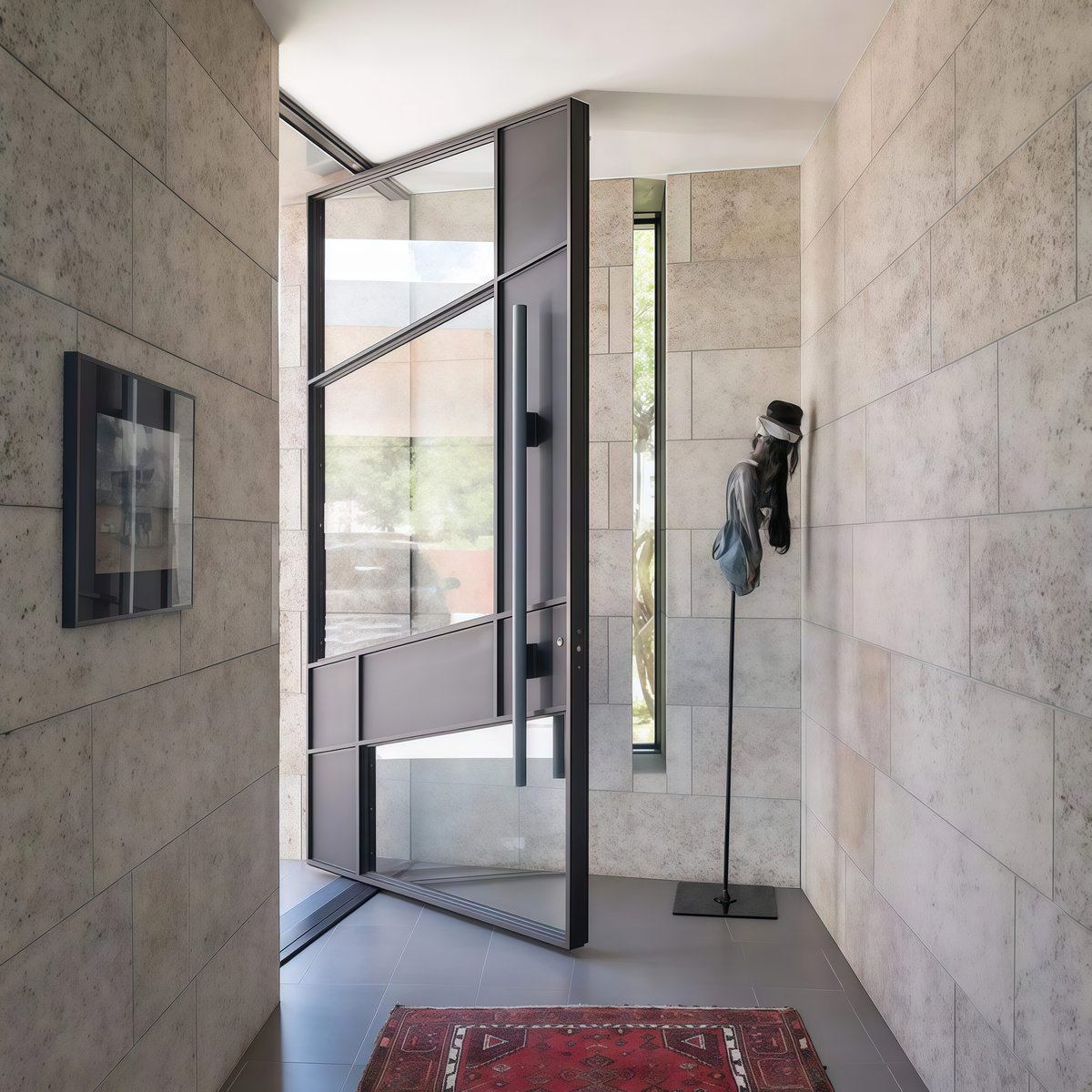
Ultimately, responsive interaction is not just a physical act of touching, but a sensory system offering continual feedback. Through the interplay of temperature level, friction, form, and security, it permits individuals to analyze the quality of a room with every door-opening activity. Consequently, the real worth of a phenomenal entry lies not in its visual improvement but in its ability to provide a constant, steady, and comfortable tactile experience every time it is understood; this "regular feeling of improvement" is usually the core, unmentioned benchmark of high-end style.
Busrom Team
Marketing Department
Committed To Providing The Highest Quality Indoor & Outdoor Solutions Worldwide.